Manjushri Bodhisattva Mini Thangka — Artwork Core Only · XTK-064 — XTK-064:57e88cb0ad9b5e069d23599170435805306b2233951eab4bf1bf2b90c8e1a2fc
The piece

Thangka Painting · Cotton canvas

Manjushri Bodhisattva Mini Thangka — Artwork Core Only · XTK-064

Catalogue preview · Not available for purchase

Manjushri Bodhisattva · 4.0 × 5.0 cm · xtk-064

The piece

Size 4.0 × 5.0 cm
MaterialCotton canvas
Artist / workshopCairang Dongzhi
OriginRegong / Tongren County, Huangnan Prefecture
Figure Manjushri Bodhisattva
Referencextk-064
One of oneYes

The work

Artwork core only. Any frame or case shown in the photograph is for presentation and is not included.

About this work

Note: Manjushri Bodhisattva is an important bodhisattva symbolizing wisdom in Buddhism. Details such as the sword, scripture, crown, garment folds and gestures may differ across lineages and artworks. The following focuses on thangka art, cultural meaning and gift blessings, and makes no claims of religious efficacy.

Key Selling Points

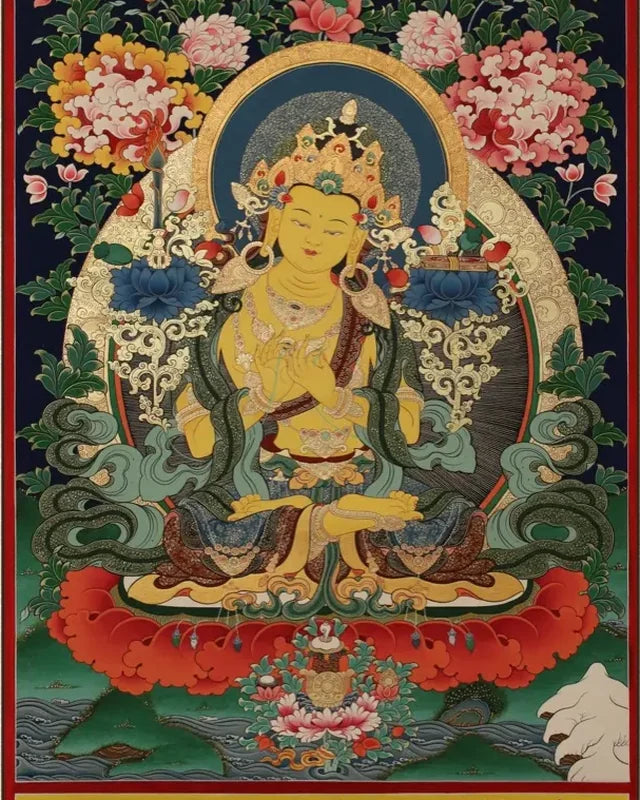
Manjushri Bodhisattva theme, symbolizing wisdom and discernment

The cultural meaning Manjushri conveys is often linked with learning, reflection, insight and clear judgment, fitting for wishes of growing wisdom and a clear direction.

Both sword and scripture, a highly recognizable classic figure

The sword of wisdom in his right hand symbolizes cutting through confusion and ignorance; the scripture on the lotus at his left represents the passing on of knowledge, right view and wisdom, a vivid theme rich in cultural meaning.

Golden body on a lotus seat, gentle calm within dignity

The deity sits steadily and composedly on a pink-white lotus; the lotus symbolizes stainless purity and adds softness and tranquility to the dignified picture.

Ink-black ground with gold scrolling foliage, ornate and layered

Fine gold patterns laid over the dark background contrast vividly with the golden figure, blue-green halo and pink lotus seat, revealing rich decoration and a hand-painted texture on close viewing.

Regong hand-painted craftsmanship, detail condensed into a tiny space

From the crown jewels, facial expression, garment folds and ribbons to the lotus petals, water patterns, halo and scrolling foliage, everything is rendered with fine linework and rich color, suited to slow, close viewing.

Cultural Meaning

The wisdom Manjushri symbolizes is not just remembering more knowledge; it is the ability to see the essence amid complexity, discern direction before choosing and keep thinking independently when confused.

The sword of wisdom in the picture can be understood as the spiritual strength to cut through confusion, bias, hesitation and needless inner friction; the scripture on the lotus symbolizes learning, settling and reflection. The decisiveness of the sword and the calm of the scripture reflect each other, reminding us that true clarity requires both continual learning and firm judgment at key moments.

The intricate gold patterns unfolding on the dark background seem to symbolize the jumble of information and thoughts in life; and the bright, settled Manjushri at the center conveys a cultural reminder: even in a complex environment, you can keep your inner clarity and focus.

The blessing this mini thangka conveys can be summed up as:

May all you learn bring gain and all you think become distinct;

may the sword of wisdom cut through confusion and your mind be clear;

may there be light on the road ahead and every step be sure and calm.

Suitable For

People preparing for exams, studying or in further training

Symbolizing focused study, clear thinking and growing wisdom, expressing a sincere wish for their learning and growth.

People in education, research, writing, design or creative work

May they keep their insight through constant thinking and creating, and find clear inspiration and direction for expression.

Friends at a life choice or career transition

Expressing a wish that they be less confused, tell what matters and move forward with composure.

Collectors who love thangka art and Buddhist culture

An elegant theme with a visually distinctive gold-scrolled background and blue-green halo, suited to quiet admiration, display and collecting.

Yourself

Keep it on your desk, in your study or workspace as a daily reminder to keep learning, stay focused and return to rational thinking.

Display and Care Suggestions

Keep the environment dry and clean, away from damp, grease and chemicals such as perfume and cleaners.

Buddhist-art themes are best displayed, stored and enjoyed in a tidy, respectful way.

Size 4.0 × 5.0 cm
Included accessoriesNone
FramingUnmounted — artwork core only; frame/case not included
MaterialCotton canvas
Artist / workshopCairang Dongzhi
Art traditionRegong school
OriginRegong / Tongren County, Huangnan Prefecture
Figure Manjushri Bodhisattva
Referencextk-064
One of oneYes

A note on what this is

We present these objects as works of art and describe their subjects and craftsmanship. We make no claim that ownership will change your circumstances.

General craft background

Notes on Black-and-Gold Thangka with Color Craftsmanship

Black-and-gold thangka with color uses a deep black ground and gold linework as its core visual language, giving an overall artistic character that is solemn, profound and luxurious. After the canvas ground is prepared, it is first glazed repeatedly with black mineral pigment or traditional ink, forming an even, steady and layered black surface; once the ground is completely stable, the figures, patterns and decorative details are painted.

The main subject is usually outlined in gold powder, mud gold or gold leaf. The painter uses gold of different depths, such as deep gold and light gold, to carefully draw the Buddha's contours, garment folds, halo, lotus petals, auspicious clouds, ritual implements and all kinds of patterns. Set against the black background, the gold lines are especially clear and bright, giving the figures' proportions, expressions and details more dignity and dimension.

The "with color" part is mainly small accents of mineral color, and does not override the black-and-gold relationship at the heart of black-and-gold thangka. Common coloring includes:

Cinnabar: for garments, lotuses, flame patterns, jewels and local red ornament;

Realgar, yellow ochre, red ochre: for the warm tones of the deity's body, robes, ritual implements and local transitions;

Malachite / mineral green: for head halos, garment folds, lotus leaves or local blue-green patterns;

Lapis lazuli / azurite blue: for crowns, sky patterns, garments and local blue ornament;

Conch-shell white: for brightening facial features, pearls, garment-fold highlights and finishing details.

After coloring, the painter continues to re-trace the edges in gold and applies gold outlining, layered gold or detail highlights in key areas, so the colors and gold lines blend naturally. Some gold areas also undergo traditional gold polishing and burnishing to enhance the fineness and layered luster of the gold, while the black background keeps a relatively quiet, subtle texture that brings out the gold lines and painted details.

In the end, black-and-gold thangka with color achieves a visual effect of "black as the ground, gold as the bones, color as the rhythm": from afar, the strong black-gold contrast is dignified and mysterious; up close, you can see dense gold lines, rich mineral colors and hand-painted patterns, combining the dignity of traditional religious art with collectible and display value.

Traditional materials palette (general reference)

This palette is general background and does not confirm that every listed material is present in this individual work.

Canvas: cotton; pigments: gold leaf, silver leaf, gold powder, silver powder, mud gold, mud silver, coarse gold, fine gold, deep gold, light gold, red gold, blue gold, 98 gold, 74 gold, cinnabar, vermilion, realgar, orpiment, red ochre, yellow ochre, stone yellow, malachite green (malachite), azurite blue (azurite), lapis lazuli, ultramarine, stone purple, amethyst powder, lime white, lead white, conch-shell white, mica powder, carbon black, pine-soot ink, mineral carbon black, indigo, earth green, mineral red, mineral brown.

General condition and aftercare guidance

Condition, Imperfections and Free Replacement Policy

Subtle differences in brushwork, the natural graininess of mineral pigments, changes in the luster of the gold under different lighting, and the slight texture of the canvas and mounting materials are all normal features of a traditional hand-painted thangka, not quality problems.

Because every thangka is hand-painted, no two works are exactly alike. Slight color differences or variations in local brushwork or pattern details caused by photographic lighting, screen display and the properties of natural materials are within the normal range.

If the work you receive has any of the following, we will replace it with a new one free of charge:

Obvious creases, damage or stains on the painting;

Damage to the canvas, paint layer or mounting that affects the overall display;

Obvious and substantial differences in color, material or craftsmanship between the item and the displayed sample;

The main image, size or core craftsmanship seriously does not match the order.

We carefully inspect every work before shipping and only send it once we have confirmed that the painting, materials, mounting and packaging are in good condition, doing our best to ensure the work you receive is complete, beautiful, and meets display and collecting standards.

Ask about this piece

Manjushri Bodhisattva Mini Thangka — Artwork Core Only · XTK-064